


 English
 русский
 Français
 Español
 عربى






 2026-10-30
 Industry News

Wheel Dolly Manufacturing at Zhejiang Vermillion
Zhejiang Vermillion Import and Export Co., Ltd. builds wheel dollies as part of a broader hydraulic machinery and maintenance tool program covering auto repair equipment, garage tools and motorcycle service equipment. The range is engineered for workshops that need to reposition vehicles and wheel assemblies without starting the engine or calling in a tow unit.
Our Wheel Dolly program is a focused manufacturer line: steel platforms, multi-directional casters and load ratings selected around the vehicles actually serviced in the bay. Distributors and project clients use it alongside our Vehicle Positioning Jack and Motorcycle Stand &Dolly lines when a workshop is laid out for vehicle movement rather than lifting alone.
What a Wheel Dolly Does in a Working Bay
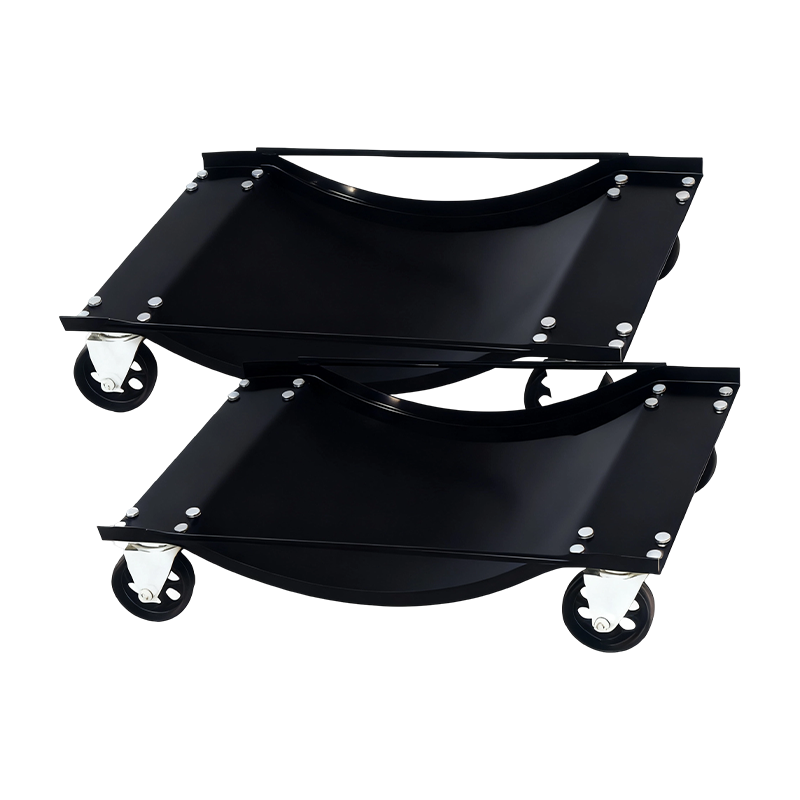
A wheel dolly sits under a tire and converts a static vehicle into a rolling load. Each unit carries one wheel on a low-profile steel platform, and the casters allow the vehicle to be pushed sideways, rotated or aligned to a lift, paint booth or storage position. The working principle is simple, but the load case is not: the platform, caster forks and frame must hold the wheel under continuous static load while resisting side thrust during steering.
Application fit is defined by three variables — vehicle mass per wheel, tire width and diameter, and the floor surface. Smooth epoxy or sealed concrete gives the best caster behavior. Expansion joints, floor drains and steel plates change rolling resistance and should be accounted for when selecting caster diameter and tread material.
- Body shops and paint preparation: moving a vehicle between prep, booth and reassembly positions without repeated lifting.
- Tire and brake bays: handling individual wheel assemblies during rotation, balancing and brake service.
- Storage and showroom areas: compacting vehicle spacing and recovering floor space.
- Truck and commercial vehicle work: repositioning oversized wheels and dual assemblies where manual handling is impractical.
Our Wheel Dolly Range and Load Positioning
The catalog is organized by capacity and handling format rather than by vehicle brand. Four models cover the common workshop profiles, from passenger car wheel handling to commercial truck assemblies.
| Model | Rated Capacity | Platform / Format | Typical Application Fit |
|---|---|---|---|
| OY12201 | 1,000 lbs | Standard-duty single platform with swivel casters | Passenger cars, light trucks and SUVs; tire rotation and brake service |
| OY12203 | 680 kg per unit | Twin-pack, 400 × 300 mm platform, two units per set | Axle work and simultaneous repositioning on both sides of a vehicle |
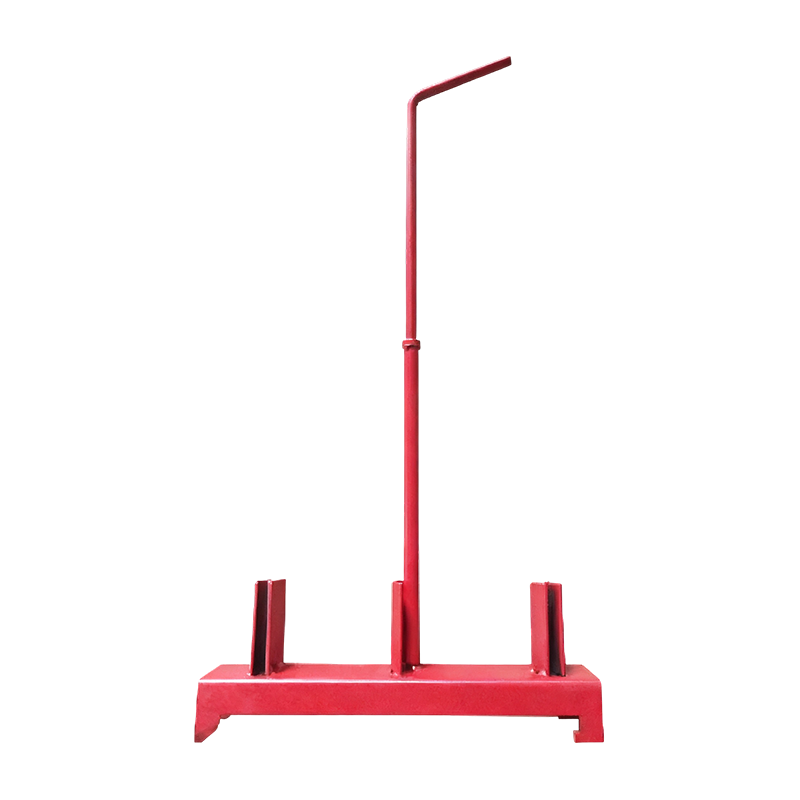
| OY12203-P | 680 kg | Pole-handle variant with upright grip | Vans, light commercial vehicles and heavier passenger cars in tight bays |
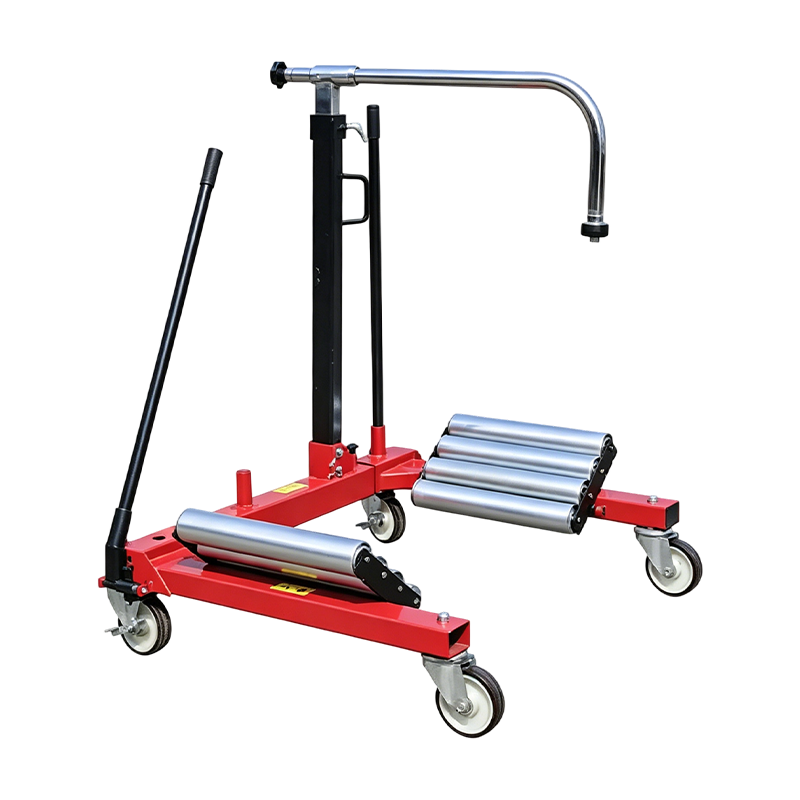
| OYTD006 | 1.5 ton | Heavy-duty truck format | Oversized truck wheels and heavy commercial assemblies |
Capacity figures are rated values per unit. In practice, a vehicle is supported by four dollies, so the per-wheel share of vehicle mass plus any transfer load during pushing determines the correct model. For a 2,000 kg vehicle, a 680 kg unit per corner leaves a working margin; for heavier vans and trucks, the 1.5-ton platform is the appropriate starting point.
Configuration Choices That Change the Build
Two dollies with the same capacity can behave very differently in service. The configuration decisions below are the ones we confirm before a quotation is finalized, because they affect frame geometry, caster selection and packaging.
Platform and Cradle Geometry
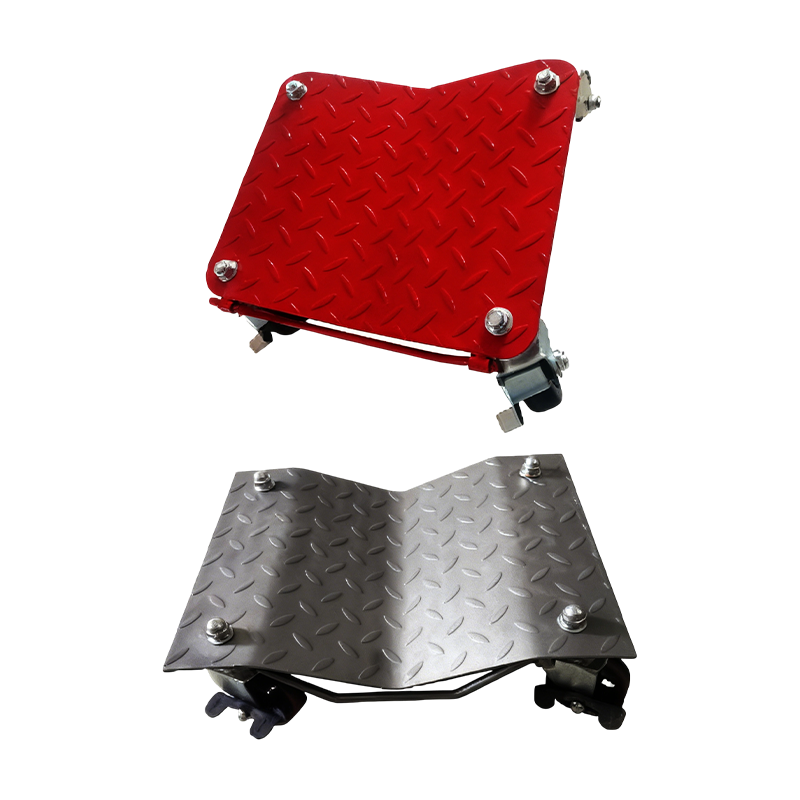
Platform length and width must accept the tire contact patch without the sidewall overhanging the frame edge. A non-slip platform surface keeps the tire seated during steering inputs. Where a workshop handles a mix of tire sizes, a wider platform with a shallow cradle is more forgiving than a narrow, tightly fitted tray.
Caster Set and Steering Behavior
Swivel casters give multi-directional movement; larger wheel diameters roll more easily over floor irregularities and reduce the push force needed to start a loaded vehicle moving. Caster mounting plates and fork thickness are structural items, not accessories, and are matched to the rated load rather than chosen for appearance.
Handle Format
Low-profile dollies are steered by pushing the vehicle body or the tire. The pole-handle format on the OY12203-P adds an upright grip point, which keeps the operator from bending to floor level and gives better control when a single unit is moved on its own. For high-frequency tire bays, the raised handle reduces the awkward low push that causes most operator fatigue.
Materials, Structure and Repeatability
Frames are fabricated from steel and assembled on standardized fixtures so that caster positions and platform planes repeat from unit to unit. That repeatability matters when a workshop buys dollies in sets: mismatched platform heights cause a vehicle to sit unevenly and make steering unpredictable.
- Frame: welded steel construction sized around the rated load, with reinforcement at caster mounting points.
- Platform surface: non-slip treatment to limit tire movement during steering.
- Castors: swivel configuration for multi-directional travel on flat workshop floors.
- Finish: coating applied for workshop conditions, with color options available under OEM programs.
Because the dolly is a passive tool, accuracy is expressed as dimensional consistency and rolling behavior rather than cycle precision. The acceptance points that matter in service are platform flatness across a set, caster swivel freedom, absence of weld distortion at the mounting plates, and stable load support without frame deflection under the rated capacity.
Quality Assurance and Compliance Evidence
Production runs under an ISO9001 quality management system, and core hydraulic products in the wider catalog carry CE certification for European market sale. Inspection is applied through the production process rather than only at final assembly, so frame and caster issues are caught before packing.
For project and distribution orders, the documentation package can include model and capacity confirmation, packing list with gross and net weights, carton dimensions and container loading quantities. Certification documents relevant to the supplied item are provided with the order so that the receiving market can complete its own import and retail compliance steps.
OEM, ODM and Private-Label Programs
Wheel dollies are well suited to private-label programs because branding sits on the platform, the carton and the manual rather than inside a sealed hydraulic assembly. We support logo marking on the product, customized color boxes and cartons, and multi-language manuals covering English, Spanish, French, Japanese and other languages.
Structural and parameter adaptation is handled by our R&D team when a market requires a different platform size, handle format or appearance. For distributors building an exclusive line, we can take a concept through prototype, sample and mass production, including testing before shipment.
Trial quantities are accepted for market testing, and pricing steps down as order volume moves toward full-container loading. This lets a distributor validate a new dolly SKU before committing to a container program.
Installation, Safety and Serviceability
Wheel dollies require no utilities, no compressed air and no electrical connection. Commissioning is limited to inspection on arrival, confirming caster swivel, and checking that the platform sits flat on the workshop floor. A level, sound floor is the main installation requirement; soft or damaged surfaces increase rolling resistance and reduce control.
- Confirm the vehicle is on level ground before loading the dollies.
- Use a matched set of four units for full vehicle movement; never mix capacities on one vehicle.
- Keep hands clear of the caster path and tire contact area while pushing.
- Inspect casters and platform surfaces before each use; replace worn casters rather than forcing a stiff unit.
Serviceability is built around replaceable casters and simple steel components. Spare casters and platform parts are supplied as low-cost service items so that a distributor or end user can return a dolly to service without replacing the whole unit. Operation and maintenance guidance is provided in the manual and in video form for technician training.
Packaging and Delivery Scope
Dollies are packed in cartons sized for container loading, with gross and net weights declared per model. The OY12203 twin-pack ships two units per carton, which simplifies handling for shops that buy matched pairs. Container loading quantities are calculated per model so that a mixed order can be planned against a single shipment.
Delivery scope typically covers the dolly units, the manual and the carton branding agreed for the order. Where a program includes a display or retail requirement, packaging artwork is confirmed before production begins.
Information We Use to Configure Your Solution
A workable proposal needs the working point, not just a model number. The following inputs let us match capacity, platform size and handle format to the actual vehicles and floor conditions in the bay.
| Project Input | Why It Determines the Configuration |
|---|---|
| Vehicle types and maximum vehicle mass | Sets the per-unit capacity and whether a standard or heavy-duty platform is required |
| Tire width and outer diameter | Determines platform dimensions and cradle geometry |
| Floor type and condition | Influences caster diameter and tread selection for rolling effort |
| Units per vehicle and order quantity | Defines set composition, twin-pack or single-unit packing, and container loading |
| Branding and manual language | Sets logo marking, carton artwork and documentation language |
| Destination market and compliance needs | Confirms which certification documents accompany the shipment |
Send the vehicle list, tire sizes and target quantity, and our engineering and sales team returns a matched configuration with capacity, platform size, packing data and quotation.
Frequently Asked Questions
How do I choose between the 1,000 lb and 680 kg models?
The OY12201 at 1,000 lbs suits passenger cars, light trucks and SUVs where one dolly carries one wheel. The OY12203 series at 680 kg per unit is supplied as a matched pair for axle work and heavier vehicles, and the OY12203-P adds a pole handle for better control in tight bays. For trucks and oversized wheels, the OYTD006 at 1.5 tons is the correct platform.
Can a vehicle be moved on four dollies at once?
Yes. A full vehicle move uses four matched units of the same model and capacity. Mixing capacities or models on one vehicle causes uneven platform heights and unpredictable steering, so sets should be kept together.
Do the dollies require any power, air or installation?
No. They are passive mechanical tools with no utility connection. Commissioning consists of inspection on arrival, confirming caster swivel and checking that the platform sits flat on a level workshop floor.
What customization is available for private-label orders?
We support logo marking on the product, customized color boxes and cartons, and multi-language manuals. Platform size, handle format and appearance can be adapted by our R&D team, and exclusive new product development can run from prototype through sample and mass production.
What certifications apply to the wheel dolly range?
The factory operates under ISO9001 quality system certification, and core hydraulic products in the catalog hold CE certification for European market sale. Certification documents relevant to the supplied item are provided with the order.
Are spare parts available after the sale?
Yes. Casters and platform components are supplied as low-cost service parts, and we provide long-term after-sales technical guidance plus operation video tutorials so that distributors and end users can maintain the units in service.
Related Products and Categories
Our portfolio also includes Products for applications with different operating ranges, interfaces or integration requirements.
