


 English
 русский
 Français
 Español
 عربى






 2026-10-30
 Industry News

Zhejiang Vermillion Import and Export Co., Ltd. manufactures hydraulic garage equipment and auto repair tools at our Jiaxing, Zhejiang base in China, and the car rotisserie is one of our established lines. Each unit mounts a vehicle body shell on adjustable arms and rotates it to the working angle you need, so floor pans, inner sills, firewall seams, rear quarter structures, underbody and roof panels are all reachable without crawling underneath or repositioning stands. Our Car Rotisserie Manufacturers range is supplied to restoration workshops, collision and body shops, custom builders, and distributors serving those trades.
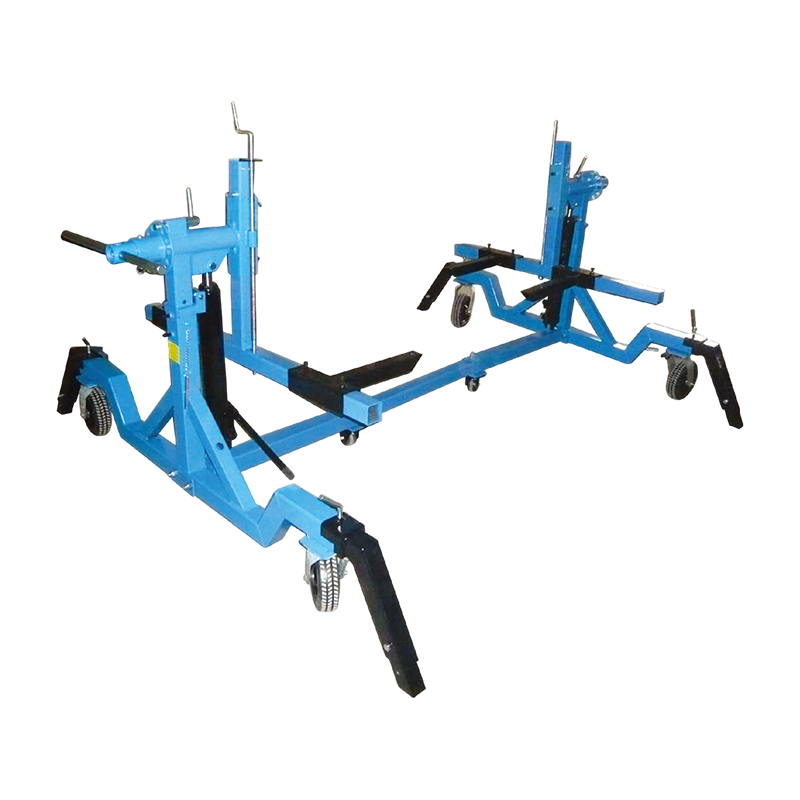
- Catalogued models: OY20953 (2000 lb standard-rotating) and OY20950 (4000 lb 360-degree).
- Capacities across the rotisserie programme run from 2000 lb to 4500 lb, sized to the shell rather than the complete vehicle.
- ISO 9001 factory quality system, CE certification on core products, 100% in-process inspection.
- OEM and ODM builds with brand marking, packaging and manual localisation.
Our Car Rotisserie Range
Both catalogued rotisseries are shipped as two upright assemblies with mounting hardware, and both are designed for one operator to rotate a mounted shell by hand. The difference between them is load class, rotation hardware and the base arrangement, which determines whether the frame is moved on casters or anchored to the shop floor.
| Model | Rated capacity | Rotation and locking | Mounting | N.W. / G.W. | Carton (cm) | 20 ft load |
|---|---|---|---|---|---|---|
| OY20953 | 2000 lb | Standard rotation with positive-engagement locking pin | Four independently adjustable arms | 200 / 220 kg | 157 × 72 × 34 | 135 pcs |
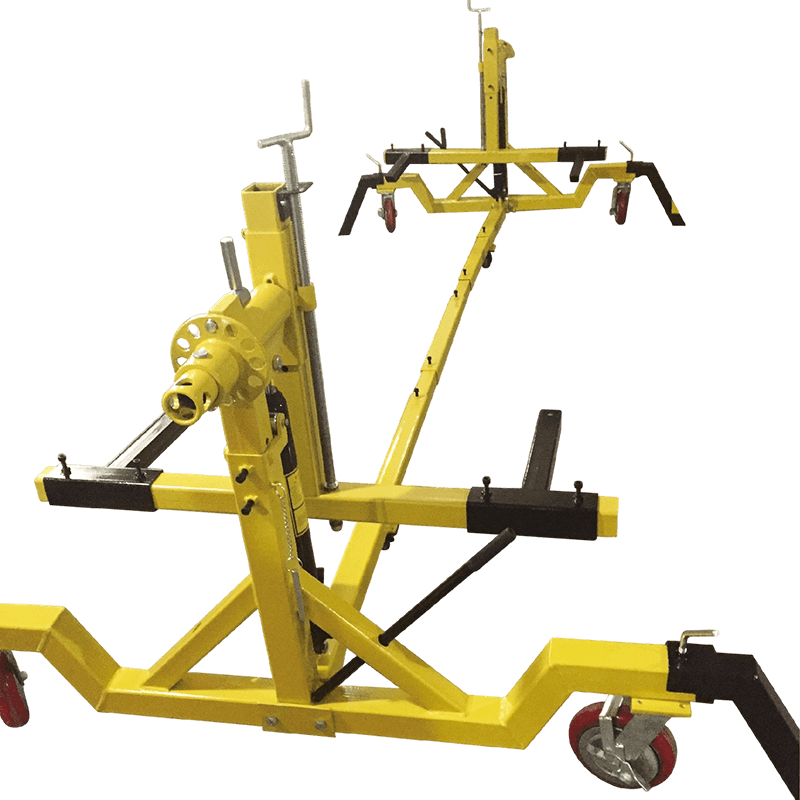
| OY20950 | 4000 lb | 360-degree rotation via manual crank or geared hand wheel; locking pins or disc brake | Two rotating mounting heads, adjustable crossbars and mounting plates | 230 / 250 kg | 154 × 75 × 37 | 62 pcs |
The 2000 lb model suits compact and mid-size shells where a lighter frame and a mobile caster base shorten set-up time. The 4000 lb model covers full-size passenger cars, light trucks and heavier classic bodies, and its wider reinforced base carries pre-drilled holes for floor anchoring when the shell will be worked on for weeks.
Body Mounting, Rotation and Locking
The mounting interface is the part of the design that decides how well a rotisserie behaves on a real restoration. Both of our units attach to the shell at the bumper mounting points or the frame rails, using adjustable arms or crossbars so the body can be centred regardless of original wheelbase or overall length.
- Independent arm adjustment — each arm or crossbar moves separately, so an off-centre or asymmetric shell can still be balanced on the axis.
- Positive locking — the OY20953 uses a positive-engagement locking pin at each rotation point; the OY20950 uses locking pins or a disc brake system.
- Locking purpose — holding the shell at angle during vibration- and impact-generating operations such as angle-grinding seam welds or stud-gun work on quarter panels.
- Single-operator rotation — crank or geared hand wheel drive on the 4000 lb unit keeps a loaded shell under control without a second person.
Frame Construction and Surface Finish
Rotisserie frames live in an aggressive environment: paint stripper, rust converter, primer aerosols and welding spatter all reach the steelwork. We build from high-strength steel with precision-welded joints, and the 4000 lb stands use thick-wall welded steel tubing that is stress-relieved for stability under full load. The finish is a two-stage paint process applied for corrosion resistance in bodywork conditions.
The 2000 lb unit sits on a low-profile caster base running standard 4-inch shop casters, so an assembled rotisserie can be pushed to another bay without dismantling it. The heavier model trades mobility for footprint stability, with a wide reinforced base that can be bolted down when the shop layout allows dedicated space.
Where a Rotisserie Earns Its Floor Space
Full-body restoration work is the core application: floor pan and rocker replacement, inner sill and firewall seam welding, rear quarter and wheel-arch fabrication, chassis repair, undercoating, seam sealing, priming and final paint. Because the shell rotates, technicians work standing at a comfortable height instead of lying underneath, which improves weld quality and shortens cycle time on long panel jobs.
Shops that run frame-off projects often combine a rotisserie with other lifting equipment we manufacture, including our Shop Crane for lifting bodies and subframes and our Engine Stand for the powertrain once it is out of the shell. For shells that must be moved between bays before mounting, a Wheel Dolly set keeps the body mobile on a level floor.
Matching Capacity to the Vehicle Shell
Rated capacity refers to the mass carried on the rotisserie, not the published kerb weight of the finished car. A stripped shell, doors, deck lid, subframes, fixtures and the mounting arms all contribute, and the working load should stay comfortably below the rated figure.
- Shell-only work on compact and mid-size cars: 2000 lb class, moved on casters.
- Full-size cars and light trucks, or shells that will carry panels during paint: 4000 lb class with an anchored base.
- Heavier or extended bodies: capacities up to 4500 lb within the programme, confirmed against your measured shell weight.
- Always confirm the span between front and rear mounting points, because arm and crossbar reach must match the shell before shipment.
Installation and Workshop Requirements
Set-up is a two-person job for the upright assemblies, and the surrounding space matters as much as the equipment itself.
- Level, load-bearing concrete floor; anchor the 4000 lb base through its pre-drilled holes when it stays in one bay.
- Clearance for a full swing: allow for shell length plus rotation radius on both sides, and check overhead height before rotating to the inverted position.
- Keep removed doors, hood and deck lid stored clear of the rotation envelope.
- Confirm the mounting hardware matches the shell's bumper mounts or frame rails; adapters are agreed before production.
Quality Control and Acceptance
Our factory operates under an ISO 9001 quality management system, with CE certification held on core hydraulic products, and we implement 100% full inspection through production rather than sampling at the end of the line. For rotisseries, that inspection covers weld quality and frame squareness, paint finish and coverage, fit of locking pins, cranks and mounting hardware, and carton protection for container transport.
The 2000 lb model is tested to 2000 lb static load as part of its CE certification scope. Where a project requires documented acceptance, we agree the inspection points and load verification method with the customer before the order is released to production.
OEM, ODM and Custom Builds
As a hydraulic tool and garage equipment manufacturer in China, we handle distributor programmes as well as single-model orders. Our OEM and ODM service covers brand marking, packaging and product adaptation:
- Branding and packaging — laser marking of your logo, colour box, carton and multilingual manuals.
- Structure and parameter optimisation — arm geometry, size, appearance and operation layout adjusted to regional standards and working habits.
- New product development — prototype design, sample production, tooling, mass production and testing for exclusive models.
MOQ is flexible on standard models, and we accept trial orders so a new market can be tested before committing to container volumes. Pre-sales technical matching and quotation support are handled by our multilingual sales and engineering team.
Information We Use to Configure Your Solution
A rotisserie proposal is only accurate when it is built around the vehicle and the workshop. These are the inputs we work from.
| Project input | Why we need it |
|---|---|
| Vehicle make, model, year and body style | Sets capacity class and arm reach |
| Measured shell weight and mounted components | Confirms the working load against rated capacity |
| Mounting point type (bumper mount or frame rail) and span | Determines arms, crossbars and mounting plates |
| Required rotation (standard or full 360 degrees) | Selects rotation hardware and locking system |
| Shop floor, anchoring permission and overhead clearance | Decides caster base versus anchored base |
| Branding, packaging, manual language and order quantity | Builds the OEM scope and container plan |
Maintenance, Spare Parts and Support
Wear items on a rotisserie are limited and predictable: locking pins and springs, casters, crank and geared hand wheel assemblies, mounting arms, plates and hardware. We supply low-cost spare parts over the life of the product so a workshop can replace these without scrapping a frame.
Documentation and support include operation video tutorials, long-term after-sales technical guidance, and replacement for quality problems. Every unit ships with its mounting hardware in a carton sized for container efficiency — 135 pieces of the 2000 lb model or 62 pieces of the 4000 lb model per 20 ft container, which suits mixed distributor orders consolidated with shop presses, jacks and stands from our wider Products range.
Frequently Asked Questions
Which capacity should I order for a full-size classic car?
A stripped full-size shell generally sits in the 4000 lb class, which is what the OY20950 is built for. Send us the measured shell weight including doors, deck lid and subframes, and we will confirm the model and whether anchoring is recommended.
Can a rotisserie hold a complete running vehicle?
Our rotisseries are mounted to a body shell at the bumper mounts or frame rails. Powertrain, suspension and wheels are removed first, and the shell is the load. That is the working method the arm geometry and locking system are designed around.
Can one person rotate a loaded vehicle body?
Yes. The 4000 lb model uses a manual crank or geared hand wheel so one operator can rotate the shell and stop it at the required angle, where the locking pins or disc brake hold it against vibration from grinding and stud welding.
Do you supply mounting adapters for different vehicles?
Mounting plates and adjustable crossbars are part of the standard delivery. If a shell needs a specific adapter pattern, we agree the drawing with you before production so the arms match the mounting points on arrival.
Can the rotisserie be produced under our own brand?
Yes. We laser mark customer logos, print colour boxes and cartons, and supply manuals in English, Japanese, Spanish, French and other languages as part of our OEM and ODM service, with structure and parameter adjustments available for regional requirements.
What order quantities and shipment sizes are practical?
MOQ is flexible on standard models and trial orders are accepted for market testing. Container planning is straightforward: 135 units of the 2000 lb rotisserie or 62 units of the 4000 lb model fit a 20 ft container, and mixed loads can be arranged with other equipment from our catalogue.
